Every Eurovision season sparks the same debate across Europe: what actually makes a Eurovision winner?
Eurovision winners rarely follow one genre or formula. Instead, success usually comes from balancing originality, emotion, staging, and mass appeal.
And according to Ipsos iSay members and visitors, the mystery may be the whole point.
In our latest Eurovision Question of the Day poll, the biggest group of respondents (28%) said Eurovision winners don’t follow any clear rule at all. Others pointed to catchy mass appeal (20.9%), staging and spectacle (17.9%), innovation (13.3%), and emotional impact (12.6%) as the biggest factors behind success.
That unpredictability appeared even more strongly when audiences were asked whether Eurovision has a winning formula at all: nearly half (47.2%) said there’s no consistent pattern to success, while 21.7% believed originality and creativity are what really win Eurovision.
Looking back at Eurovision winners through the decades, it turns out every single group may be right.
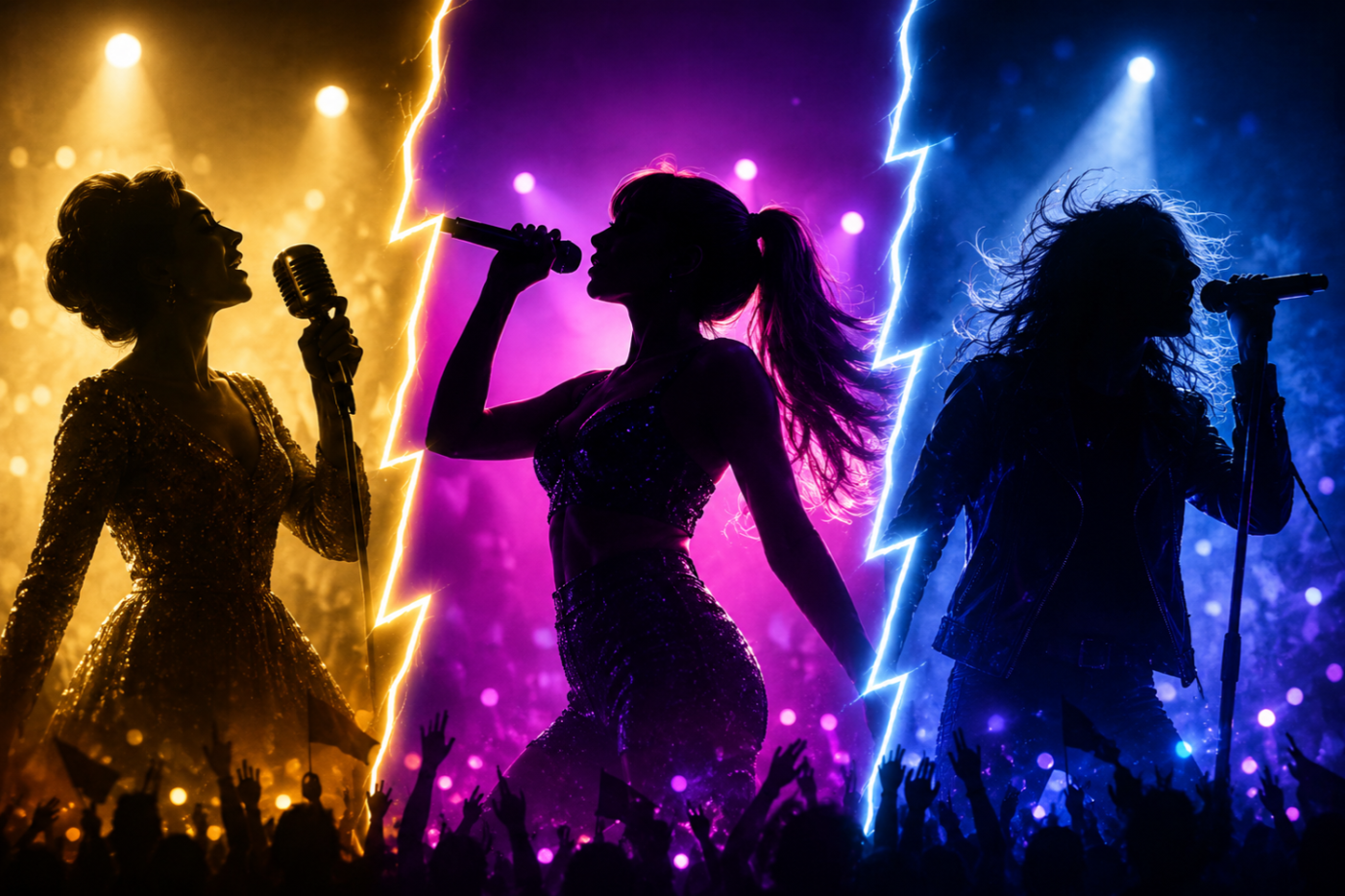
*AI-generated visual for illustrative purposes.
The Early Eurovision Years Belonged to the Ballad
In Eurovision’s early decades, emotional ballads dominated the scoreboard. During the 1950s, 1960s and much of the 1970s, winners often relied on huge vocals, dramatic orchestration, and timeless love-song storytelling.
Songs like France Gall’s “Poupée de cire, poupée de son” for Luxembourg in 1965, Brotherhood of Man’s “Save Your Kisses for Me” in 1976, and Johnny Logan’s legendary “Hold Me Now” in 1987 showed how Eurovision rewarded emotional connection and memorable melodies. Then came Céline Dion representing Switzerland in 1988 with “Ne Partez Pas Sans Moi,” delivering the kind of soaring ballad performance Eurovision became famous for.
Even decades later, the formula never fully disappeared. Portugal’s Salvador Sobral won in 2017 with the intimate jazz-inspired ballad “Amar Pelos Dois,” proving that a quiet emotional performance could still beat louder, more theatrical competitors. Duncan Laurence followed in 2019 with “Arcade,” another stripped-back emotional song that later became a global streaming hit.
That emotional power still resonates with Eurovision fans today. In Ipsos iSay polling, 12.6% of respondents said strong lyrics and vocal performance matter most when it comes to Eurovision success.
Then Pop Took Over Eurovision
Everything changed in 1974 when ABBA won Eurovision with “Waterloo.” The performance didn’t just win the contest; it transformed Eurovision itself. Suddenly, Eurovision wasn’t only about orchestras and traditional ballads anymore. It became a launchpad for international pop music. From that moment on, catchy choruses, memorable hooks, and radio-friendly songs became increasingly powerful.
The winning formula of the 1990s and 2000s often leaned heavily toward polished pop anthems. Sweden perfected the formula repeatedly, producing slick, modern performances designed to dominate both juries and playlists. Loreen’s “Euphoria” in 2012 became one of Eurovision’s most successful modern pop songs, while her 2023 winner “Tattoo” proved atmospheric Scandinavian pop still has enormous Eurovision power.
Other winners followed similar paths. Denmark’s “Only Teardrops” mixed folk-pop with an instantly memorable chorus. Germany’s Lena won with the quirky, radio-friendly “Satellite.” Israel’s Netta transformed “Toy” into a viral global phenomenon.
It’s no surprise that 20.9% of Ipsos iSay members believe catchiness and mass appeal matter most today. In the streaming era, Eurovision songs no longer disappear after one Saturday night. They live on through TikTok clips, Spotify playlists, memes, reaction videos, and festival playlists all summer long.
Why Unpredictable Eurovision Songs Still Win
And yet, just when audiences think they understand Eurovision, the contest completely changes direction again.
In 2006, Finnish hard rock band Lordi arrived dressed as monsters and won with “Hard Rock Hallelujah,” shocking viewers across Europe and proving Eurovision could reward something completely unexpected.
Then came winners who mixed genres in ways Eurovision had barely seen before. Ukraine’s Ruslana combined folk influences with explosive choreography in “Wild Dances.” Måneskin brought raw glam rock energy with “Zitti e buoni” in 2021 before becoming international stars. Kalush Orchestra blended rap, hip-hop and Ukrainian folk music in “Stefania.
In 2024, Switzerland’s Nemo won with “The Code,” a performance that jumped between opera, rap, drum-and-bass and pop within a single song. It was bold, theatrical, emotional, and impossible to categorise.
More recently, Loreen’s performances became masterclasses in visual minimalism, while Croatia’s Baby Lasagna turned humour and chaos into a viral Eurovision moment. Then came Bulgaria’s surprise 2026 victory with Dara’s “Bangaranga,” a performance that mixed bold staging, modern pop, and strong cultural influences in a way that instantly stood out from the competition.
The victory reflected what many Ipsos iSay respondents believe: Eurovision success rarely comes from copying one winning style. The strongest entries combine emotion, originality, and performance at exactly the right moment.
That unpredictability is exactly why 47.2% of Ipsos iSay respondents now believe there is no clear Eurovision formula at all, while another 21.7% believe originality and creativity are what matter most.
What the Eurovision Winner 2026 Reveals About the Contest Today
The Eurovision winner 2026 added another layer to the long-running debate about what makes a Eurovision winner. Bulgaria’s DARA won with “Bangaranga,” a performance that combined modern pop energy, bold staging, cultural confidence, and instant audience appeal. Rather than confirming one fixed formula, her victory showed how today’s strongest entries often bring several Eurovision success factors together at once.
Why Eurovision Staging Matters More Than Ever
Modern Eurovision is no longer judged by music alone. Today, staging can completely transform a performance.
Some Eurovision entries are remembered less for the song itself and more for the visual moment attached to it. Think about Måns Zelmerlöw interacting with animated projections during “Heroes,” Conchita Wurst standing beneath golden lights during “Rise Like a Phoenix,” or Verka Serduchka becoming a Eurovision icon through sheer performance energy despite not actually winning.
Eurovision is no longer watched only on television. Performances now spread instantly through TikTok clips, livestream reactions, music playlists, GIFs, memes, and viral social media moments. A single unforgettable visual can travel across Europe within minutes.
Nearly 18% of Ipsos iSay respondents now believe spectacle and staging matter more than genre itself and in the social media era, that makes complete sense.
So, Is There Actually a Eurovision Formula?
The answer may be both yes and no.
Certain patterns absolutely exist. Catchy pop songs regularly perform well. Emotional ballads never truly disappear. Strong staging has become essential in the modern contest. But Eurovision also rewards surprise. Every time the contest starts feeling predictable, something unexpected wins instead. That’s what keeps Eurovision fascinating after nearly 70 years.
Audiences want familiarity, but they also want discovery. They enjoy polished pop songs but still celebrate their originality. They love spectacle yet continue to reward authenticity. And perhaps that’s the closest Eurovision has to a real winning formula: finding the perfect balance between something people instantly recognise and something they’ve never seen before. Which means next year’s winner could be a heartbreaking ballad, a viral pop anthem, an experimental rock song, or something completely impossible to categorise.
And honestly, Eurovision fans wouldn’t want it any other way.
What Do Eurovision Fans Think?
One thing Eurovision fans seem to agree on is that there’s no single formula for success and that unpredictability may be exactly why the contest continues to captivate millions across Europe every year.
The latest Ipsos iSay Eurovision Question of the Day results showed audiences remain divided on what really creates a winner, from emotional ballads and catchy pop hooks to originality, staging, and pure surprise.
Want to share your own opinions on the biggest cultural moments, trends, and debates happening across Europe? Join Ipsos iSay to take part in daily polls, surveys, and conversations while earning rewards for sharing your views.
*These results represent Ipsos iSay web visitors across Europe, conducted May 14 – May 18, 2026, and may not reflect the views of the general population.