Do parents trust teachers in the US? In this article, we delve into the complex relationship between K-12 parents and educators in the United States. Ipsos surveys reveal a significant majority of parents trust teachers with curriculum decisions, transcending political divides.
However, opinions are split on who should primarily decide what is taught in schools, with varied views among parents, the public, and teachers themselves. This article explores these dynamics alongside teachers' perspectives on their profession, including challenges related to compensation, workload, and public perception.
This article is based on the findings of an NPR/Ipsos poll conducted May 8-12, 2023, by Ipsos using our KnowledgePanel®. This poll is based on a representative probability sample of 510 K-12 teachers who are adults aged 18 or older.
Join us as we unpack these nuanced insights into the evolving landscape of trust in American education.
With Ipsos iSay, you can contribute to impactful research like this and shape future trends with your insights and opinions. Plus, enjoy earning rewards as you make your voice heard. Haven't joined yet? Sign up today and be part of the conversation!
With Ipsos iSay, you can contribute to impactful research like this and shape future trends with your insights and opinions. Plus, enjoy earning rewards as you make your voice heard. Haven't joined yet? Sign up today and be part of the conversation!

Key Findings
- Three-quarters of K-12 parents trust their child's teacher to make decisions about classroom curriculum, which likely showcases a foundational trust in teachers' professional judgment across various political affiliations.
- Nearly three-quarters of K-12 teachers (73%) believe that public perceptions of their role have worsened over the past decade, which may indicate a disconnect between teachers' experiences and public perception.
- Eighty-one percent of K-12 parents support teaching about the history of slavery, racism, and segregation in public schools, perhaps reflecting a consensus on the importance of comprehensive and inclusive education across political lines.
- About seven in ten Americans (69%) and four in five K-12 teachers (79%) disagree that public school teachers are paid fairly, likely highlighting concerns about compensation and workload in the teaching profession.
- Despite challenges, 80% of K-12 teachers say they are happy they became teachers, which may demonstrate a strong passion and commitment to the profession despite economic and societal hurdles.
Do Parents Trust Teachers in the US?
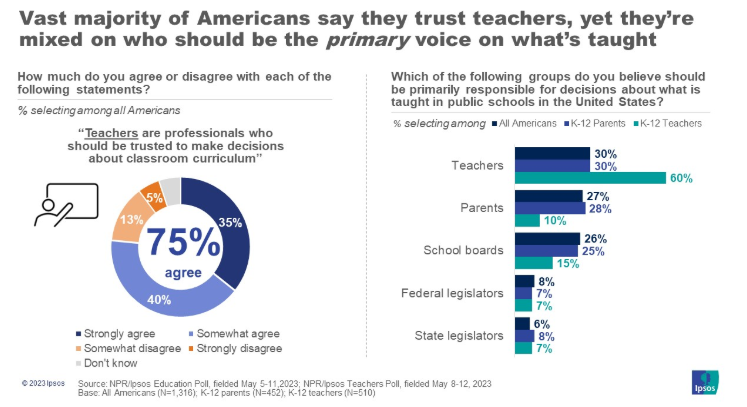
In the United States, the trust between parents and teachers plays a pivotal role in shaping the educational landscape. A significant indicator of this relationship is reflected in recent findings, where three-quarters of K-12 parents say they trust their child's teacher to make decisions about classroom curriculum.
This trust is not confined to political boundaries; it spans various political affiliations, with 84% of Democrats, 67% of Republicans, and 74% of independents echoing this sentiment. This majority view underscores a crucial aspect of the American education system: a foundational trust in teachers' professional judgment and capabilities.
Are Teachers Trustworthy? - Discover Diverse Perspectives
Trust in teachers is a multifaceted issue, influenced by various factors, including cultural, social, and political elements.
It's not just about whether parents believe teachers can effectively teach their children, but also about how teachers are perceived in terms of their role in society, their professional autonomy, and their ability to handle sensitive educational content.
This complexity is what makes the topic of teacher trustworthiness both intriguing and vital to understand in the context of children's education.
Trust in Teachers: A Nationwide View
The nationwide view of education professionals, including local teachers, reveals some concerning trends. Nearly three-quarters of K-12 teachers (73%) feel that public perceptions of their role have worsened over the past decade, indicating a need for better understanding and support of their profession.
This perception indicates a growing disconnect or misunderstanding between what teachers experience and what the public perceives. Despite the high level of trust from parents, this statistic suggests that teachers feel undervalued or misrepresented in the broader societal context.
Interestingly, this sentiment is not fully mirrored in the general public's view, as only about half of Americans say the same.
With Ipsos iSay, you can contribute to impactful research like this and shape future trends with your insights and opinions. Plus, enjoy earning rewards as you make your voice heard. Haven't joined yet? Sign up today and be part of the conversation!
The trust in teachers does not vary across political lines, especially when it comes to the content of education. A notable statistic in this regard is that eighty-one percent of K-12 parents say they support teaching about the history of slavery, racism, and segregation in public schools.
This support transcends political affiliations, with a majority of Americans, including 85% of Democrats, 78% of Republicans, and 78% of independents, agreeing on the importance of these topics in education.
This consensus among parents from different political backgrounds highlights a shared understanding of the value of comprehensive and inclusive education.
Challenges in the Teaching Profession
The teaching profession, revered for its impact on future generations, faces significant challenges in the modern era. One of the most pressing issues is the perception of fair compensation and workload. About seven in ten Americans (69%) and four in five K-12 teachers (79%) disagree that public school teachers are paid fairly.
Additionally, three-quarters of Americans (75%) and nine-tenths of K-12 teachers (93%) say that teachers are asked to do too much work for the pay they receive. This statistic likely highlights a growing concern about the sustainability and attractiveness of the teaching profession in the current economic climate.
The Dilemma: High Trust, Low Desire for Teaching Careers
Despite the high level of trust parents place in teachers, there is a noticeable apprehension regarding the teaching profession as a viable career choice for their children.
This apprehension is rooted in economic concerns, as 66% of K-12 parents say they would be worried about their child's financial future if they wanted to be a teacher. This statistic underscores a paradox in the education sector.
While teachers are trusted and valued for their role in shaping young minds and influencing the post-high-school plans, the profession itself is not seen as financially rewarding or stable.
Teachers’ Satisfaction in the US
In contrast to the challenges and concerns, there is a silver lining when it comes to teachers' job satisfaction. Despite all the reported challenges that K-12 teachers face in their classrooms today, the vast majority (80%) still say they are happy they became teachers in the first place.
This statistic reflects a deep-seated passion and commitment among educators, suggesting that despite the hurdles, the intrinsic rewards of teaching continue to resonate with those in the profession.

Sensitive Topics in Public Education
Public education is often at the forefront of societal change and debate, making it a breeding ground for discussions on sensitive topics. These topics range from curriculum content to the role of political and social ideologies in education.
Handling Controversial Subjects: Teachers vs. Parents’ Expectations
The handling of controversial subjects in education is a balancing act between teachers' professional judgment and parents' expectations. Two-thirds of K-12 parents, and 69% of all Americans, say they oppose state lawmakers passing book bans. Roughly three in five K-12 parents (60%) and Americans (64%) say the same for individual school boards.
Additionally, about three in five (62%) K-12 parents and about two-thirds of Americans overall (67%) say they oppose state lawmakers restricting what subjects teachers and students discuss in the classroom. Another 56% of K-12 parents and 64% of Americans at large say the same for individual school boards.
These statistics may reveal a general consensus against censorship and academic freedom in the classroom, reflecting a desire for a comprehensive and diverse education system.
The Political Landscape and Its Impact on Public Schools and Education
The role of politics in education, particularly in shaping racial and ethnic diversity and other sensitive topics, is contentious.
Fewer than one in ten Americans and K-12 parents believe that federal (8% and 7%, respectively) or state legislators (6% and 8%, respectively) should be the primary decision-makers in public schools, indicating a preference for decisions to be made closer to the local school leadership.
A similar percentage of K-12 teachers say the same (7% for both state and federal legislators). This statistic likely indicates a general reluctance to politicize education and a preference for educational decisions to be made by those within the educational system rather than by external political entities.
Parental Involvement and Expectations
The dynamics between parents and schools is a crucial aspect of modern education. This relationship is characterized by mutual expectations and evolving roles, significantly impacting the education overall.
The Evolving Role of Parents in Public School Education
In recent years, the evolving role of parents in children's schools has become increasingly significant. 42% of K-12 parents and 46% of K-12 teachers report a decline in the quality of local schools over the past decade, highlighting concerns about the current state of children's education.
Forty-four percent and sixty-six percent, respectively, say that working conditions for teachers in their area have worsened in the past ten years, too. This statistic reflects growing concerns about the state of education and highlights the need for effective parental involvement in addressing these challenges.
Balancing Parental Input and Educational Expertise
Balancing parental input with educational expertise, especially in areas like child psychology and child's grades, is crucial. Despite the overwhelming trust K-12 parents have in teachers, there is a split in opinion on who should primarily make decisions about what is taught in public schools.
About three in ten Americans say teachers (30%) or parents (27%), and about a quarter (26%) say school boards. Among K-12 parents, 30% say, teachers, 28% say parents and 25% say, school boards.
Moreover, K-12 teachers are less divided than parents over who should be primarily responsible for what is taught in public schools: 60% say, teachers, 15% say school boards and 10% say, parents.
The Future of Teacher-Parent Relationships
The future of teacher-parent relationships is an area of keen interest, with potential changes and developments that could reshape the educational experience.
Anticipating Changes in Educational Dynamics
Anticipating changes in educational dynamics, it's expected that the relationship between teachers and parents will continue to evolve. Over half (56%) of K-12 parents note that their local community has recently faced teacher shortages, signaling potential shifts in school leadership and classroom dynamics.
This statistic, along with changing educational needs and societal shifts, suggests that the future will bring new challenges and opportunities for teacher-parent collaboration.
The Importance of Teacher–Parent Communication
In response to these anticipated changes, developing strategies for enhancing trust and collaboration between teachers and parents is essential.
While just under half of Americans in urban (50%), rural (45%), and suburban (45%) areas report that they have recently experienced teacher shortages in their community. Under one-fifth of Americans from each area type say the same for recent book bans or restrictions on classroom discussions.
This highlights the need for open dialogue and cooperative efforts to address common educational challenges and goals.
FAQs
Are Teachers Needed in the USA?
Yes, teachers are very much needed in the USA. There is a consistent demand for qualified teachers across the country, particularly in subjects like mathematics, science, and special education. Additionally, certain regions and urban areas face more significant teacher shortages, indicating a strong need for educators.
Is It Worth Becoming a Teacher in the US?
Becoming a teacher in the US can be very rewarding, though it comes with its challenges. While it may not be the most financially lucrative profession, many teachers find great satisfaction in making a positive impact on students' lives. The decision to become a teacher should consider both the passion for educating and the practical aspects of the profession.
How Are Teachers Treated in the USA?
The treatment of teachers in the USA varies widely depending on the location, school district, and community. While teachers are generally respected as professionals, they often face challenges such as high workloads, underfunding, and varying levels of support from parents and administrators.
Recent trends show a growing appreciation for teachers, especially in the context of their adaptability and dedication during challenging times.
Wrapping Up: Trust and Challenges in the US Education System
In conclusion, this article provides a comprehensive analysis of the multifaceted relationship between parents and teachers in the American education system. It reveals a significant trust in teachers' abilities to make curriculum decisions.
However, it also uncovers a split in opinions on decision-making authority in education, reflecting diverse perspectives on teacher trustworthiness. The article highlights the challenges that teachers face, including issues of compensation and workload, and explores the evolving dynamics in teacher-parent relationships.
This exploration into the educational landscape offers valuable insights into the current state of trust, the complexities of educational roles, and the future of teacher-parent collaboration in the United States.
We invite you to share your opinion through Ipsos iSay surveys. Visit your dashboard to find surveys, participate, and make your voice heard.