In a world that often seems fraught with challenges and uncertainty, it's refreshing to find evidence of positive trends. The 2023 Ipsos Global Happiness Report, a comprehensive study of happiness levels around the world, offers some encouraging news. But what makes people happy?
The world's happiness level is on the rise
On average, nearly three in four (73%) adults globally describe themselves as happy, a 6% increase compared to 2022. Ipsos measured the relationship between all respondents’ reported levels of happiness and level of satisfaction with 30 aspects of life (such as health, relationship with spouse, children, job, free time, financial situation, etc.)
Which are the happiest countries in the world in 2023?
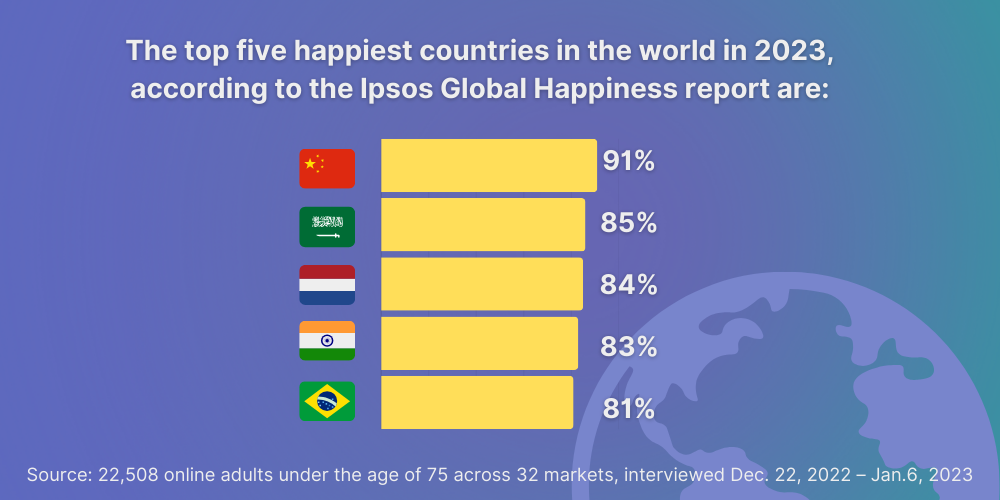
China has the highest happiness score in the world. Nine in ten (91%) Chinese adults describe themselves as happy.
The top five happiest countries in the world in 2023, according to the Ipsos Global Happiness report are:
- China (91%)
- Saudi Arabia (86%)
- Netherlands (85%)
- India (84%)
- Brazil (83%)
Portugal (79%) comes on spot number 12, followed by France (16th) and Sweden (17th) both with 7 in 10 (74%) people saying they are very/rather happy.
Happiness across the world
Let's connect on our social media platforms, where we delve into these topics, share updates, and foster a community of informed individuals.


Local Insights: what life aspects give people the highest satisfaction level in different countries?
Curious to see where your country stands? Check out the full report:
While some common factors contribute to life satisfaction, there are also some local differences. For example, in the Netherlands or the US, life satisfaction is often linked to having a good relationship with their partner/spouse. In Saudi Arabia and Singapore, life satisfaction is often associated with the level of personal safety and security. In Argentina, life satisfaction is often linked to the level of education one has.
To gain a broader understanding of what the future may hold, we invite you to explore our article on the '5 Global Trends for 2024'. This comprehensive study provides insights into the societal, economic, and technological shifts that might shape our global community, attitudes, and indeed happiness, in the upcoming year.
The happiness gap is narrowing between high-income and middle-income countries.
In the past, there was a significant gap in happiness levels between high-income and middle-income countries (~10% in 2020). However, this gap has narrowed in recent years (overlap in 2022 and ~8% in 2023).
High-income country citizens tend to be more satisfied with their safety, material possessions, living conditions, and jobs.
Middle-income country citizens are generally more satisfied with their faith/spiritual life, physical well-being looks, relatives, sense of control and purpose, and feeling appreciated.
The United States: A Mixed Picture – How happy are Americans?
The United States ranks 14th in the world in terms of happiness, with 76% of American respondents saying they are very or rather happy. This is a slight improvement from last year, but the US still has a long way to go to catch up to the happiest countries in the world. Some of the challenges facing the US include the country’s social and political situation (35%) or the country’s economic situation (34%).
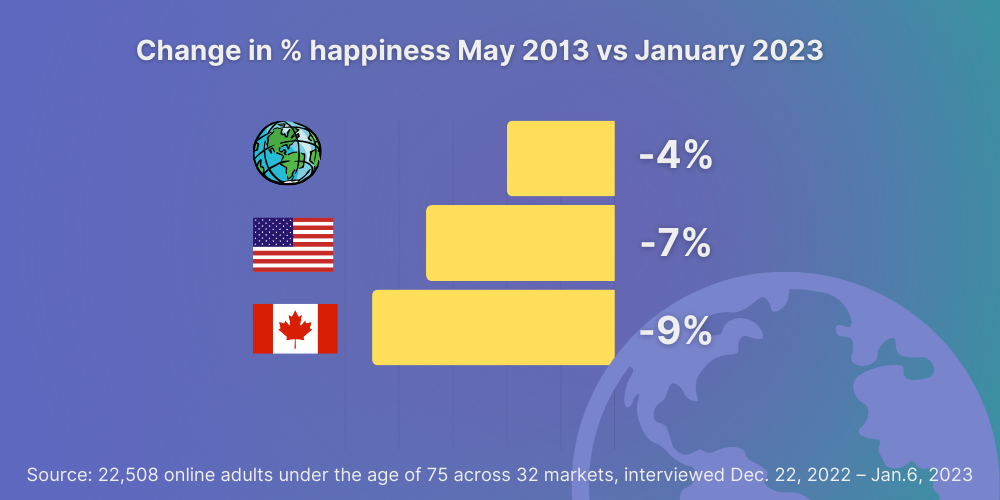
10-year change in happiness levels
What is happiness and what factors drive happiness levels, according to the 2023 Ipsos Global Happiness Report?
What can we do to increase our happiness? While there are many things that we can’t control, there are also steps that we can take to increase our happiness.
Here are some life aspects that have a higher impact on our happiness level, as voted by adults globally:
- Social support/ Connectedness: Strong social connections and a sense of belonging and being loved are essential for happiness.
- Having a sense of purpose and being in control of our lives/ Freedom: Feeling free to make choices and express oneself is important for well-being.
- Physical and mental health: measured in the following life aspects – faith or spirituality, free time, physical appearance, health and fitness, romantic life, living conditions, and ownership of material possessions.
Since social support is the main and most important, globally, to have an impact on the level of happiness, the study finds many lack a support system.
Globally, only 72% have friends or relatives they could rely on to help them. Significantly fewer in Japan (54%), Brazil (58%), France (69%) and Italy (70%), and generally among lower-income earners (64%).
Our insights come straight from the 2023 Ipsos Global Happiness report. If you’d like to dive deeper into the key learnings from the happiness report, you can also watch this Ipsos webinar.
Having unravelled the insights from the 2023 Ipsos Global Happiness report, we're eager to continue the conversation and hear your thoughts on these compelling findings.
Ipsos iSay?
We are Ipsos iSay, a global community of people who are passionate about making a difference. We are committed to using our voices to improve the world around us.
Why not join us? If you're interested in taking part in studies like the Global Happiness report and sharing your thoughts and opinions on a variety of topics, we encourage you to register on ipsosisay.com.
As an Ipsos iSay member, not only will you help us better understand the world and make informed decisions, but you'll also earn Ipsos iSay points for each survey you complete. These points can be redeemed for a variety of rewards, including gift cards, or PayPal cash... How great is that?
Together, we can create a happier and more equitable world.