If love really makes the world go round, 2026 suggests the planet is spinning steadily, just not always in sync.
The Ipsos Love Life Satisfaction 2026 survey, covering 29 countries and over 23,000 adults, paints a vivid global picture: where you live, how much you earn, and whether you’re married, all shape how loved and how romantically fulfilled you feel.

1. The Global Pulse of Love: Warm, but Not Blazing
Love is alive and well around the world, just not necessarily setting hearts on fire.
Across 29 countries, 77% of people say they’re satisfied with how loved they feel, and 83% of those with a partner are happy in their relationship. But when it comes to the romantic or sexual spark, only six in ten say they’re truly satisfied.
In other words, we’re feeling cared for and are mostly content with our partners, but not everyone feels equally satisfied with every aspect of their relationship experience.
Interestingly, these feelings are surprisingly consistent across gender and generations.
- Men (76%) and women (77%), young and old, are largely on the same wavelength.
- Around three-quarters of every generation report feeling loved: Gen Z (76%), Millennials (77%), Gen X (75%), and Baby Boomers (79%).
Older generations edge slightly ahead, perhaps thanks to experience or simply lower drama levels, but no one is far behind.
⭐Globally, love isn’t in crisis. It’s calm, steady, and reassuring; a reminder that being loved often matters more than chasing fireworks.
2. Where in the World Is Love the Strongest?
Love is universal, but its strength depends on where you live.
The Love Life Satisfaction Index (0–100)* combines satisfaction with feeling loved, romantic and sexual life, and the relationship with a partner or spouse.
Globally, Latin America and parts of Asia dominate the “love-rich” end of the spectrum, while Japan (51 satisfied with feeling loved) and South Korea (60) report the lowest satisfaction across all dimensions.
Europe and North America largely fall in the mid-range globally, with meaningful variation within each region.
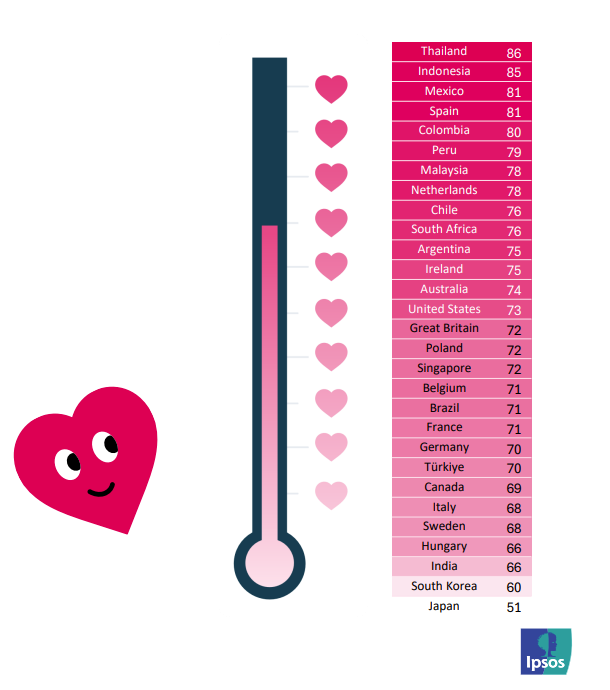
Global Love Life Satisfaction Index – Highlights
3. Love and Happiness Go Hand in Hand
Thailand (86) and Indonesia (85) top the Love Life Satisfaction Index (0–100)*. This aligns with findings from the Ipsos Happiness Report 2026, where Thailand is 3 percentage points happier than last year.
We also touched on this in our previous article Feeling Happier Already? You’re Not Alone, where Indonesians highlighted feeling appreciated or loved as a key driver of happiness - reinforcing the link between feeling loved and overall happiness.
This connection reinforces a simple but powerful idea: in places where people feel more loved, happiness tends to follow.
4. Should You Put A Ring On It..
The global love story isn’t over…
The Ipsos Love Life Satisfaction 2026 survey shows that, while most of us feel loved and content in our relationships, the romantic spark isn’t always blazing.
Across generations and continents, love is steady, reassuring, and deeply tied to overall happiness—but it isn’t always fireworks.
But this is just the beginning. 💌 Don’t miss Part 2, coming soon, to see the full global love picture.
*Source: All data from the Ipsos Love Life Satisfaction 2026 survey, conducted online between 24 December 2025 and 9 January 2026 among 23,268 adults across 29 countries.
Every survey response helps us better understand how people think, feel, and experience the world around them.
Keep sharing your opinions on Ipsos iSay, you never know what fascinating insights we'll uncover together next. 💜